

Mathematics
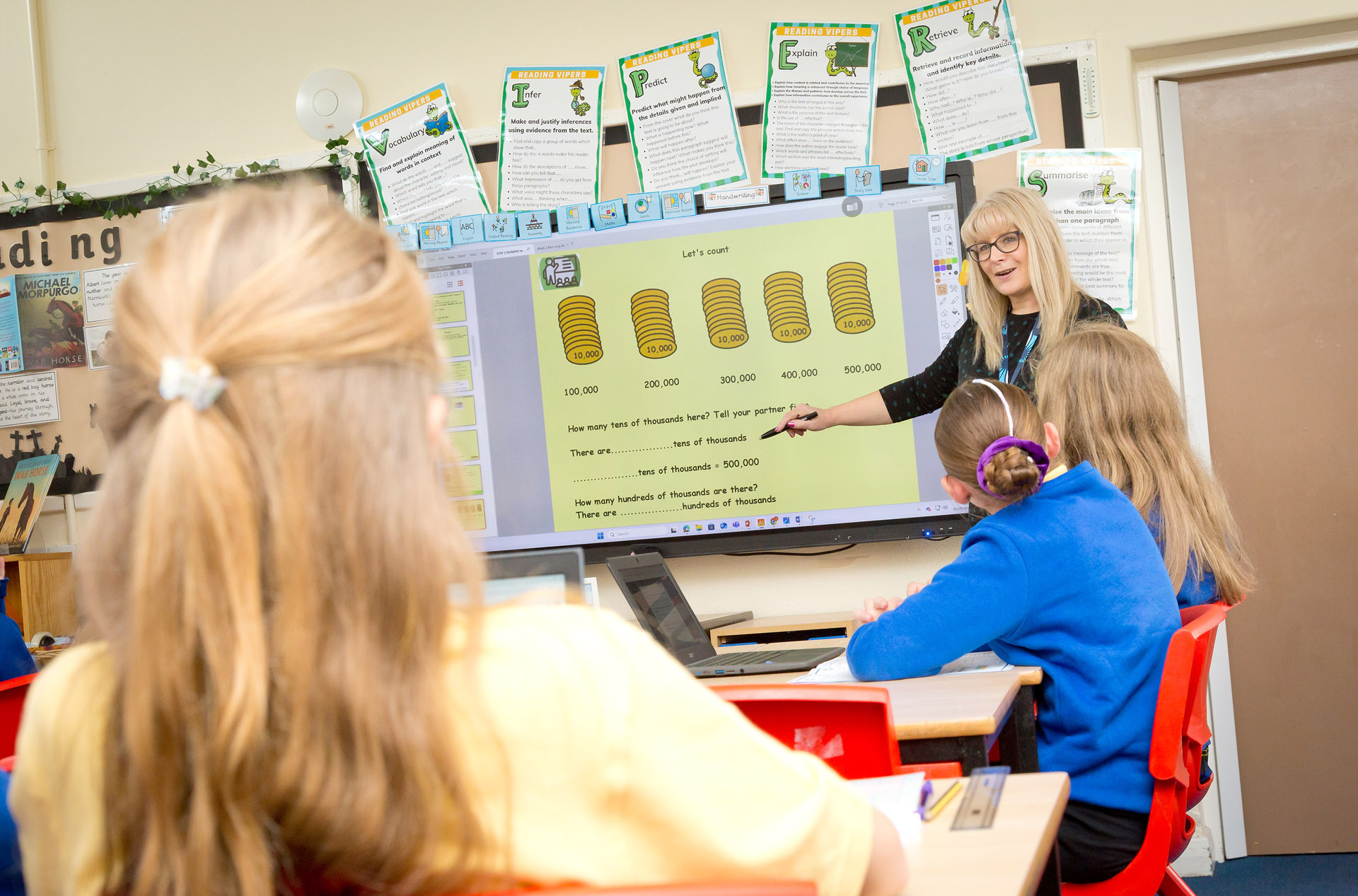
Mathematics is a core subject of the National Curriculum and is taught daily across the whole school (EYFS, Key Stage 1 and Key Stage 2).
Foundational Knowledge
At East Park Primary School, we believe that a strong mathematical foundation is the key to creating confident, successful, and efficient mathematicians.
Mastering the core fundamentals—including correct number formation, deep number sense, and a fluent recall of number bonds and times tables—allows children to make meaningful mathematical connections as they progress. When these core concepts become second nature, pupils can direct their energy toward complex problem-solving and critical thinking.
To support our pupils on this journey, we use engaging rhymes and visual representations designed to embed a deep, lasting understanding of mathematics from the very beginning.
In EYFS, the emphasis is to support children in order to allow them to develop a strong grounding in number and numerical patterns. Children also experience the importance of shapes, spatial reasoning, and measure as part of their mathematical learning journey. Maths is experienced through a range of adult and child led activities which are practical and based within a context. Children are encouraged to deepen their understanding through problem-solving in real life contexts. For example: making a house for the three little pigs with a specified amount and type of shapes.
In Key Stage 1 and Key Stage 2, the basis for all of our mathematics teaching follows three basic principles:
- To become fluent and develop a conceptual understanding with the ability to recall and apply knowledge rapidly and accurately.
- To reason mathematically which includes proving mathematical statements.
- To problem solve in a range of contexts.
The curriculum is organised into areas called domains. Each term, the children will be taught a range of concepts through place value, addition and subtraction, multiplication and division, fractions, decimals and percentages, measurement, geometry and statistics. In addition, the year six curriculum includes algebra, ratio and proportion.
At East Park Primary School, we follow a mastery curriculum and believe that all children can be successful mathematicians. In all lessons, we aim to follow the approach of concrete, pictorial and abstract concepts.
Lessons have a consistent structure throughout the school and consist of guided practise, fluency, variation and mastery challenges.
HOW TO HELP AT HOME
-
Spot the Math in Everyday Routines
Turn daily activities into quick number sense moments. Count steps as you walk up the stairs, ask your child to lay out the correct number of forks for dinner, or have them help measure ingredients when baking. Pointing out maths in the real world builds instant connections.
-
Keep Times Tables & Number Bonds Short and Frequent
Five minutes of practice a day is far more effective than an hour once a week. Use short car journeys, the walk to school, or brushing teeth to chant times tables, play "ping-pong" with number bonds to 10 or 20 (you say 7, they say 3), or practice number rhymes together.
-
Use Visuals & Concrete Objects First
Before expecting mental speed, let children see and touch the numbers. Use physical items—like buttons, LEGO bricks, or pieces of fruit—to group items into multiplication arrays or build number bonds. Seeing why 6 + 4 = 10 makes the memory stick much deeper than memorizing facts alone.
East Park Mathematics Intent, Implemetation and Impact
Long Term Planning
Policies
East Park Mathematics Calculation Policy